Memory and Forgetting
Norwegian WoodMemory and Forgetting in Norwegian Wood is not simply the preservation of the past but an unstable relation between sensory traces, absent people, and the living person who tries to recall them. Toru Watanabe’s adult recollections of Naoko begin with a meadow rendered in extraordinary detail, yet the people who once occupied it have vanished from the image. Writing becomes his way of keeping a promise to Naoko, even as he recognizes that neither recollection nor truthful understanding can restore the dead or abolish grief.
The Meadow and the Absent Figures
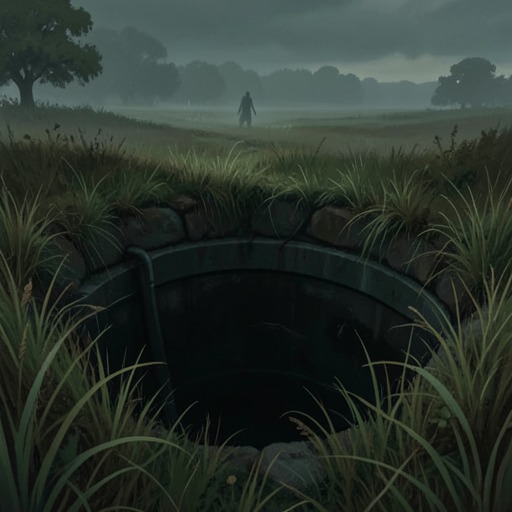
Eighteen years after walking with Naoko through a meadow, Watanabe can summon its October setting with startling precision: rain-washed mountains, tall grasses stirred by the wind, a strip of cloud across a blue sky, and two red birds startled into flight. At the time, however, he barely attended to the scenery. His thoughts circled around himself, the beautiful girl beside him, and the complicated love he felt. The later vividness of the landscape therefore records not what he consciously valued then, but what memory has selected and preserved.
In the present of the narration, the meadow returns before its people do. Grass, wind, hills, and a dog’s bark come back with clarity, while neither Naoko nor Watanabe appears in the remembered scene. Even Naoko’s face does not arrive at once. He reconstructs it through separate impressions: her cold hand, straight black hair, a tiny mole beneath her earlobe, the camel-hair coat she wore in winter, and the slight tremor in her voice. The face emerges only after these fragments have been joined. Memory is thus both intimate and incomplete: physical particulars survive, but they do not make the person wholly present.
The delay itself lengthens over time. What once took five seconds to remember takes ten, then thirty, then a minute. Watanabe imagines the shadows growing until they are swallowed by darkness, while the October landscape keeps returning like a recurring film image. Its persistence does not mean that the past is intact; the scene becomes a kind of summons to wake up precisely because the people at its center are missing.
A Promise Made Against Forgetting
During a walk in the woods, Naoko asks Watanabe to remember that she existed and had stood beside him. She says that his visit has made her happy and hopes that it will help save her. He promises to remember, and later assures her that he will never forget. The exchange gives memory an interpersonal meaning: it is not merely private recall but a responsibility one person asks another to carry.
Watanabe’s later account repeatedly tests that promise. He fears he may have forgotten what mattered most, imagining important memories gathered in a dark inner limbo and slowly turning to mud. His anxiety does not stop him writing; it makes the act feel urgent. He says that writing is the only way he knows to keep his promise. The account is not presented as a perfect record recovered from the past, but as an effort made from the imperfect materials that remain.
When he was younger and the memories seemed sharper, Watanabe often tried to write about Naoko but could not begin. The abundance of detail made it difficult to choose a starting point, like a map showing so much that it becomes useless. With time, he comes to understand that writing can hold only imperfect memories and thoughts. Paradoxically, as his recollections of Naoko fade, he feels able to understand her more deeply. Remembering is not the same as possessing an unchanging image of her: the imperfect act of telling becomes a form of attention to what cannot be recovered whole.
Grief, Recollection, and the Dead
The novel connects memory to Watanabe’s earlier understanding of death. After trying to distance himself from painful associations in his new life at the dormitory, he finds that the losses he has known remain within him as a vague knot. That knot takes the form of the idea that death exists not as life’s opposite but as part of life. The thought helps him make sense of how the dead persist in the lives of those who remain, but it does not prevent later sorrow.
After Naoko dies, Watanabe leaves Tokyo and moves down the coast, sleeping on the sand, making fires from driftwood, and thinking about her while he listens to the waves. He cannot absorb that she is dead. Her image and their bodily memories seem immediate, as though she were still close enough to touch; at the same time, he knows that her flesh no longer exists in the world. During sleepless nights, one recollection opens into a flood: Naoko cleaning the aviary in a yellow raincape, her tears soaking his shirt over a collapsed birthday cake, her winter coat, the hairslide she habitually touched, and her posture on the sofa in a blue nightdress. These details return not as a settled portrait but as memories that overwhelm him.
In these episodes, Watanabe experiences an imagined place where Naoko lives with the dead and can still speak with him. There, death is one element of life rather than a boundary that ends it; the remembered Naoko reassures him that death need not disturb him. But the consolation cannot last. The tide of memory recedes, leaving him alone on the beach, where sadness returns as tears. The alternation between immersive recollection and desolate absence makes memory a temporary passage toward the dead, not a permanent reunion.
Watanabe concludes that the philosophy he drew from Kizuki’s death cannot answer the grief Naoko’s death brings. No truth, sincerity, strength, or kindness can cure the sadness of losing a loved one. The mourner can only live through it and learn from it, and what is learned offers no protection against the next grief. The distinction matters: the novel does not dismiss understanding, but refuses to treat understanding as a remedy that cancels loss.
The Living, the Dead, and What Memory Cannot Restore
Watanabe’s memory of Kizuki also changes as he grows older. Nearly two and a half years after Kizuki’s death, playing pool with Hatsumi, he realizes that Kizuki did not come to mind until the first game had ended and he bought a Pepsi. He feels guilty, as if the delayed recollection amounted to abandonment. He then recognizes a painful difference between preserving the dead and preserving the life once shared with them: Kizuki remains seventeen, while Watanabe is approaching twenty, and part of what they experienced at sixteen and seventeen has already disappeared. The emotional consequences of Kizuki’s death remain vivid, but that vividness cannot return their shared past.
After returning to Tokyo following Naoko’s death, Watanabe shuts himself in his room for days, feeling defiled and fixed on the dead rather than the living. He spends much of his time in rooms set aside for Naoko, their furniture covered and windowsills dusty, and imagines speaking to Kizuki about her death. These closed rooms give physical shape to a life organized around absence. Memory here does not simply honor the dead; it also withdraws Watanabe from the living person still present in his life.
Across these scenes, the novel holds two claims together. The dead continue to inhabit the living through remembered gestures, places, and sensations, yet memory changes, arrives late, and can never bring back the person as a whole. Watanabe’s writing preserves the promise that Naoko existed, not by defeating forgetting, but by making the effort to remember visible. Its deepest limit is also its emotional force: the record can bear witness to love and loss, but it cannot make either one reversible.